Thursday, October 27, 2011

Depressions economic & meteorological

Researchers have claimed to find a causal relation between weather & the outcome of elections.

Major volcano explosions in the past have had long term effects on world weather, farming & economy.

I wonder if any research has been done into the relationship, if any, between weather & economic depressions.

The sudden brief burst of Indian summer in this country only added to the sense of doom & anxiety about the economy. Just another piece of evidence, after the long run of no summer & unaccustomed winter snows not previously experienced by anyone under the age of forty or so, that we are living in a world turned upside down.

I do not suggest that the weather causes recession as such, at least not in economies which are not largely dependent on harvests, but may influence the speed of recovery. The last thing politicians need when they are trying to encourage a sense of come on, we can get out of this quagmire of debt.

There is some possibly good news however. According to the cash machine group Link, Friday Sept 30 was the busiest day of the year so far - £577m of cash withdrawn before the hot weekend. Unless of course everybody decided on just one last fling before hatches are well & truly battened.

Wednesday, October 26, 2011

Mortal souls

In his chat about the Life Scientific with Jim Al Khalili, Steven Pinker gave short shrift to the idea of something so immaterial, let alone immortal, as a soul.

But what about a mortal soul? The force that keeps that matter together in a package called me for as long as we both shall live?

Deaths of rhythm

Leonard Dillon died on 28 September at the relatively early age of 68.

In 1965 he released a record under the name of Jack Sparrow. His backing harmonies were provided by a group unknown outside Jamaica – the Wailers.

In 1966 he formed the Ethiopians, inspired to the name by the visit of Haile Selassie to Jamaica.

Those early records were more ska or rock steady than reggae, sweeter & more to my taste than the harder-edged reggae to come.

Last Saturday came the astonishing news of the death of another Caribbean musician, Trinidad-born Edmundo Ros – astonishing because I had no idea that he was still alive, at the age of 100.

He was such a fixture on the BBC – first radio then tv – in my childhood & so was responsible for inculcating in me a love of Latin rhythms. The image of that burly figure stays with me - & his voice wasn’t half bad either, gravel pebbles in a velvet purse.

The Queen must have fond memories of him too – the news reports of his death have all mentioned that she danced her first dance in public to his music.

One wonders why he had to wait until 2000 to get his OBE.


Tuesday, October 25, 2011

A word for entrepreneurs

Regardless of what the Met Office may say, local traders have spotted many an opportunity for business in the threat of a cold hard winter to come.

This morning for instance, local radio carried adverts from one company offering portable gas heaters & a competitively priced delivery service for replacement cylinders, & another, which usually celebrates the virtues of conservatories, offering purpose built car ports & covered walkways ‘so you can get in & out without the aid of a shovel'.


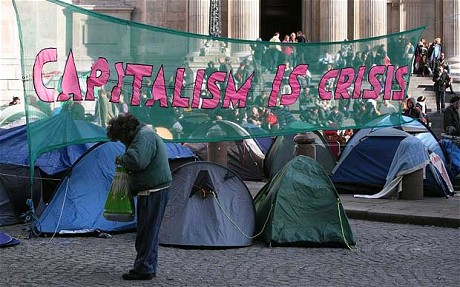
Even the anti-capitalist protestors in London are not averse to a bit of enterprise. I heard one of their number, invited by Radio 5 to respond to the claim by the Metropolitan Police that most of their tents are empty at night, explain that the absent occupants were out scouting for alternative camp sites nearby in the event that they were forced to leave the area outside St Pauls.


'They are being entrepreneurial,' he said. 'There’s nothing anybody can do to get rid of us now.'


Photo: JULIAN SIMMONDS via The Telegraph website

Hand to mouth intelligence

By another happy coincidence the result of a study of teenagers IQ was published just as I finished reading the David Bellos book about translation – Is That A Fish In Your Ear?

The admittedly small study by scientists at UCL overturns received wisdom by showing that IQ is not fixed by the time you get to adolescence; a number of the children studied showed a very distinct improvement.

Even the researchers wondered if some sort of measurement error might be to blame – until they noticed a correlation with scans which showed changes in the areas of the brain associated with speech & hand movements.

No suggestion – yet – of causal correlation.

Having given short shrift to the idea that it is grammar that makes language, Bellos asks What is it that unambiguously identifies some set of sounds made by humans as a language?

Bellos points to the strange connections between mouth & hand. ”There is no language in the world that is ever spoken aloud without accompanying hand movements … the greater the effort of concentration on live speech, the more the speaker needs to move their hands … try watching conference interpreters behind their glass screens.”
Speaking is not the same thing as reading aloud from a written text.

Television newscasters keep their hands on or under the desk or just shuffle papers – because they are only pretending to talk to you – in fact reading a teleprompt. A lecturer who moves his hands is almost certainly adlibbing, one who keeps his hands to his sides or grips the desk is reading a script.

Conversely, delicate finger-work of a non-linguistic kind almost always prompts movement of the lips. Watch someone threading a needle – hardly anyone can do it without pursing or twisting their mouths. [Does the same thing apply to someone who is struggling to see the eye of the needle & the end of the thread?]

Bellos goes on to point to the other important activity which links hand to mouth: eating.

Speaking & eating use almost all the same muscles.

Facility with language is an important component of IQ in its cognitive sense. The close relationship with eating raises intriguing questions about the relationship of diet to IQ, as much in the textures of food (involving different kinds of exercise for those muscles) as in its biochemical composition, & in the manner of its eating (hand, knife & fork, chopsticks).

For infants & young children, whose muscular control is not fully developed, eating & speaking at the same time can be quite dangerous. A child who is nervous about eating solid foods may be slow to develop. A relaxed & happy child eating with the family may learn from more than just the social & linguistic interaction.

But what, specifically, might happen to teenagers to enable them to make up lost ground?

Monday, October 24, 2011

Power outage

We had a power cut overnight – the first since the last I wrote about.

Don’t know how long it lasted; I was woken at around 5.30 by the flashing display on the radio clock, or possibly by the sudden return of the steady background hum which you never notice until complete silence descends.

Bear with a sore head.

Small things

An intriguing article on the Economix blog by Floyd Norris points to a little used index of US department store inventory prices which reveals that inflation in the price of women’s underwear is way higher than in any other category of goods in this market. Norris wonders if the price of cotton can really provide the explanation, since this has been falling recently.

Well I am far from being an expert in the price of women’s underwear, but I can confirm that the price of basic white cotton briefs in budget outlets such as George at Asda has rocketed. Not long ago you could buy three perfectly serviceable pairs for £1; now you get 4 pairs for £2.50. An increase of 87.5% in unit price.

Let us hope that the reining back in the price of cotton means at least no further increases.

My rather abstemious attitude to the purchase of undergarments resembles that of American men, who simply do not buy enough of the stuff to justify a separate statistical category in the inflation figures. But I can confirm that the price of a basic George t shirt for a man (plain round neck, short sleeves, surprisingly good quality cloth & stitching, any colour you like as long as it’s white, size up to XXXL) has also risen steeply, from £3 to £5 for two.

Sleep in a slipper

Perils of internet shopping – a man in east London ordered a single furry slipper from a specialist firm in Hong Kong called Monster Slippers. Just the one because the poor man has odd feet; his left foot, UK size 13, can presumably be catered for in an ordinary shop, but not his left foot size 14 ½.

Something got lost in translation & back came a slipper with a foot 25 inches long & the other dimensions increased to match. The Times says that this is a size 1450, but I think they have mistakenly added a 0 to that. The company blames a ‘translation error’ & say they thought the customer wanted a novelty for a shop window display.

Be that as it may, a black furry slipper measuring some 7 feet by 4 feet by 2 feet is to go on sale on line, & will hopefully fetch enough at least to cover the purchasers costs.

I should love to know if he paid up front, & still thought he was getting a bargain price for the size of slipper he was expecting.

If so I might order one myself. It looks like a wonderfully warm sleeping bag for an icy winter with energy prices too high to leave the heating on all night

Sunday, October 23, 2011

If I were

A The trivial.

If I were Hitler, I would do exactly as he did.

Well of course

B The empathetic.

If I were a Palestinian … a man … an Irish Republican …

I am trying to understand things from your point of view, to understand how or why certain behaviours which seem strange, could be, even are, completely rational within the parameters of your experience of the world & what you consider to be rational or logical

C The didactic.

If I were you, I would not wear that dress ... I would kick him out ... I would go & talk to your childs teacher ... I would always grill lamb chops, never roast them in the oven.

Couched in the language of advice, perhaps empathetic, but perhaps completely uncomprehending of the others problem

Harry Graham’s Breakfast

This is a poem for all the owls of this world who are simply not capable of human interaction first thing in the morning, but turn out quite nice really after a good breakfast accompanied by the reading matter of their choice.

Breakfast

The perfect breakfast, all must own, is that which man enjoys alone
Peace, perfect peace, is found, they say, only with loved ones far away
And there is naught but solitude that suits the matutinal mood.

But there, alas! are tactless folk who choose that hour to jest and joke
Whose conversation, brisk and bright, just bearable perhaps at night
Fills with intollerable gloom the self-respecting breakfast-room.

Thus, as I verily suspect, are many happy households wrecked
So, when you break your morning fast, let no one share that first repast.

Dean Cope, the eminent divine was breakfasting at half-past nine
Perusing (as he munched his toast) ‘The Anglican or Churchman’s Post’
When in there blew, to his distress, the Bishop of the Diocese
(Most typical in size and girth of the Church Militant on Earth)
Who shouted “Cheerio, old chap” and gave the Dean a playful slap.
Alas! What ill-timed bonhomie, the Dean inhaled his kedgeree
And turning, with his face all black, he slapped the breezy Bishop back.

Both lost their tempers there and then, and in a trice these holy men
Began (with the most unholy zeal) to throw the remnants of the meal
At one another! Buttered eggs, Bespattered aprons, gaitered legs
Were splashed with bacon, bits of sole, fell thick on cassock, alb, and stole
The dining-room became a sea of struggling Christianity
And when at last the luckless Dean slipped on a pat of margarine
The Bishop took a careful shot and brained him with the mustard pot.

A sight to make the angels weep! How scandalized the local sheep
Who read descriptions of the scene in ev’ry Parish Magazine.

The Diocese was deeply shocked. The Dean degraded and unfrocked
Found refuge in a city slum, lay-reader to the Deaf and Dumb
The Bishop lost his See, and sank to rural Prebendary’s rank
No, longer in his breezy way he reads the Collect for the Day
Or chants what proper hymns there be for those of Riper Years at Sea.

At Matins and at Evensong his cry goes up, “How long! How Long!”
His groans are heard through aisle and apse, bewailing his untimely lapse
As he repents him of the crime of being bright at breakfast time.

Saturday, October 22, 2011

Species

According to a paper by Michael Hammer, et al. in Proceedings of the National Academy of Sciences, reported in The Times 6 September 2011, interbreeding between our ancestors & other ancient human species was common until about 40k years ago.

Chris Skinner, human origins scientist, Natural History Museum commented:
This paper helps to cement the view that the line dividing our ancestors from their closest relatives is blurred rather than distinct. It makes you question species definitions.

Species are categories that humans create based on underlying biology, but mammals, including humans, don’t play along. Bonobos & chimps hybridise today, & this [paper] shows that in the past we were much the same


Mess

The bin men had an extra task to perform this week – making sure that every bin was adorned with a 6”x 8” sticker, in bound-to-be-noticed yellow & black.

IMPORTANT NOTICE
Do not put cardboard in this bin

We are now collecting cardboard in your blue bag, along with paper. If your blue bag gets full, please put your paper & cardboard in carrier bags & put them out with your blue bag on recycling collection day.

We will not collect this bin if you put cardboard in it

We have had to make this change because of new national regulations preventing the collection of cardboard mixed in with other types of organic waste
This leaves quite a mess to be sorted out. Each household has two large wheelie bins, one of which can now be used only for what one hopes will be mostly small amounts of waste food & garden clippings. There is talk of providing us with a third bin to replace the recycling boxes & blue plastic bags we use for other recyclables, but a very large proportion of houses simply do not have space for three bins in the yard.

Let us hope that at least the carrier bags we are to use as a stopgap will continue to come free from the supermarket for the duration of these difficulties.

Friday, October 21, 2011

Infinity on a scaffold

I just love this one.

Scientists have set up a large experiment to count the number of grains of sand on a beach in Cornwall. To do this they have needed to erect over 130 feet of scaffolding. It has taken five years to set it up.

Seriously, they are counting how many grains are moved up & down by the tide, to provide new fundamental information about the process of coastal erosion.


To see a world in a grain of sand,
And a heaven in a wild flower,
Hold infinity in the palm of your hand,
And eternity in an hour.
William Blake - Auguries of Innocence


Official ticking off

I read the O’Donnell report on l’affaire Fox as containing a severe ticking off for civil servants in the MOD.

For example:
14 (pt).Private office attendance was offered for both the visits set out above and declined by Dr Fox. This should not have been allowed to happen.

18. … the very large number of instances where Dr Fox met Mr Werritty overseas, and the damage arose because of the frequency and extent of these contacts and that they were not regulated as well as they should have been.

20. I therefore propose a stronger and clearer system which is better understood by Ministers and officials alike.

23 (pt). The damage arose because the frequency, range and extent of these contacts [with Mr Werrity] were not regulated as well as they should have been and this was exacerbated by the fact that Dr Fox did not make his department aware of all the various contacts.

24 (pt). Mr Werritty should not have been provided with access to Dr Fox’s diary and itinerary.

25. The Cabinet Office was not aware of Mr Werritty ...

All these amount to saying that the civil servants were just not doing their job properly – & that the Cabinet Secretary should have been informed if the minister would not listen to their concerns.

Ministers certainly picked up on this point; for example in the debate on Wednesday Sir George Young said, in reply to Angela Eagle:
If she reads the report, she will see that what went wrong was that the permanent secretary did not raise the issue with the Cabinet Secretary
If this were an episode of Yes Minister, the Cabinet Secretary would be informed over a drink in the privacy of a gentleman’s club. I wonder how things work in these days of gender equality?

Thursday, October 20, 2011

Schrodinger’s head

You are about to toss a coin. The chances are equal – 50/50 – that it will come down heads or tails.

The toss is now completed.

But this is a thought experiment. The toss was carried out under controlled conditions in a laboratory; you tossed it over a wall which is, say, 2 feet taller than you (so you cannot see over it); made out of sheet metal (so you cannot see through it); extremely thin (so you cannot jump & pull yourself up to peek over the top without slicing right through your hand); an integral part of the moulded structure of the lab so you cannot dismantle it without tools which are not available; you are naked (so you cannot use your clothes to make pads to protect your hand); there is no movable furniture in the room; every conceivable control is in place.

On the other side of the wall the coin is most definitely either heads or tails.

On your side of the wall it is still 50/50, both head & tail at the same time.

No fly zone

The other morning I was idly shooing away a small black aphid which had somehow got into the kitchen (I had been doing a spot of pruning in the back yard) when it struck me, with some force, that I have not seen a single house fly this summer. Not had the aerosol out once.

Nor last year either, I don’t think. Now that I do come to think of it.

All those rain clouds must have silver linings after all

Wednesday, October 19, 2011

Talking about Linda

Let’s talk about Linda.

In the beginning we are presented with 6 items of information about her which, we are invited to believe, are severally & collectively, true (P=1).

We are then invited to consider which of two further statements is more likely to be true: that she is a bank clerk or that she is both a bank clerk & a feminist.

The first statement comes as a surprise to those of us with our cultural background, or would have done before the current economic emergency: it is very unlikely (P close to zero) that someone with a philosophy degree would be working as a bank clerk. So what do we do?

Well, perhaps, carelessly forgetting that this second statement also contains the idea that Linda is a bank clerk, we just opt for the more likely second half.

Or perhaps we hurriedly revise our decision to reject the first statement (the information comes after all from someone who is an expert on Linda), but still opt for the second statement to reflect that process which we have undergone, of learning & revision in the light of new information .

But when we understand the fallacy, we might look back to the beginning. And reflect on the odd conclusion that the original introductory statement about Linda is even less likely to be true than the one which makes her both a bank clerk & an active feminist.

Probability all depends on where you stand.

We may also be reflecting what is odd, disturbing, but true: that the probability that I am me is even less than the probability that I exist at all. When the sperm met the egg, the I that I undoubtedly am carried only the tiniest probability of me.

I am what I am because of a lifetime of contingencies.

Rubbish

It was by pure chance that I heard last night an 'urgent announcement' on local radio that we are to have another change in the rules about how we sort our waste – after 28 October cardboard must no longer be put with food waste & garden clippings because of ‘changes to organic waste regulations.’ I find from the web that this was announced by press release on Monday. Explanatory leaflets for householders will follow (the online version has already changed).

Thanks for the notice! At least our green bin collection is this week so I am not faced with the prospect having to fish out the cardboard - if I were the reaction would just be to say sort it yourself.

A neighbour spent a chunk of Saturday morning tearing & flattening the packaging from a new set of bedroom furniture so that it would go into the bin but I fear not enough people will find out in time to prevent several loads of waste having to be diverted to landfill in the next few weeks.

I haven’t been able to find any trace of these new regulations – the Environment Agency website still says that ‘Biodegradable wastes include food wastes, garden wastes and cardboards’.

I wonder in what sense the word organic is being used here, but I note that the earliest meaning recorded in the OED is ‘Designating the jugular vein. Obs. rare.’

Much more of this & I shall be going for somebody’s jugular

Tuesday, October 18, 2011

Political zoo

Somehow animals have become inescapable in our political discourse of late – puppies, kittens … & now a fox.

The resignation of Liam Fox as Secretary of State for Defence, however inevitable & deserved, brought about by his own seemingly foolish & incomprehensible behaviour, feels & seems a tragedy. I have been trying to work out why I should feel this way since his brand of politics is not one with which I feel automatic sympathy.

I knew his attempt to ride out this storm was doomed as soon as I saw the front page headline on Friday’s Times: Fox’s friend was funded by private intelligence group – a view confirmed by The Times itself on Saturday: Times report on private donations marks end for Defence Secretary.

Speculation has it that this tangle of unofficial relationships & finances was there to support Mr Fox’s own independent foreign policy agenda which, if true, is extraordinary & ought to see him forever out of favour with Parliament & party.

An alternative, less venal, explanation could be that it was just a kind of left over from the four years which the Shadow Secretary for Defence devoted to mastering his brief so that he would be ready to take over when the Conservatives returned to power, & not a new boy totally the prisoner of ‘the departmental view.’

I have written before about the way in which I felt nervous at the prospect of Labour coming to power in 1997 poorly prepared for the realities of office & running departments. This is a real problem – how does a Party not in office provide potential ministers with the briefing & expertise they will need.

For this, & other perfectly respectable intentions, there is no reason why they should not pick the brains of outside experts. And, once again, this Fox affair raises the question of how we finance this process honestly & fairly in an age when political parties cannot raise the finance from a mass membership, we do not want our politicians to be drawn solely from among the independently wealthy classes, & when private sector, free market ideas of entrepreneurship, consultancy, selling yourself & networking hold sway.

We are told that Dr Fox devoted himself diligently to this task over the four years that he was Defence Secretary in waiting; I know that I couldn’t be an effective politician but that we do need them, & I admire him for his energy & enthusiasm in pursuing his ambitions; most commentators have suggested that he has done a good job since taking office, not least in getting a grip on the Walter Mittyish or Micawberish attitudes to budget cuts which the MOD has displayed in recent decades.

The Times front page article rather alarmingly described the three identified donors who supported Dr Fox’s personal interests as a ‘private intelligence group’, a ‘property investor who lobbies for Israel’ & a ‘venture capitalist keen on strong ties with Washington’. Ooh er, obviously dodgy. James Bond saves us from people like that.

Elsewhere we could read that these could alternatively be described as a company which provides ‘strategic advice & corporate intelligence’ with a charitable arm whose adviser is the sainted Lord Ashdown of Norton-sub-Hamdon; a philanthropist with a passion for the ‘promotion of peace & understanding between peoples’; & a hedge fund owner whose latest project is to save the Readers Digest.

The newest channel of finance for these private activities of Dr Fox & his young adviser is a not-for-profit company called Pargav whose accounts ‘have been seen by The Times’. On Friday I assumed this meant something like accounts filed at Companies House, but a longer article on Saturday (byline Billy Kenber, a graduate trainee as recently as February) makes it clear that these accounts include details of payments made using the company’s debit card, which don’t seem like the kind of thing normally on the public record.

Some of these details are used by Kenber to suggest that at least three people had the use of this debit account.

On December 20th a card was used in Sri Lanka; on December 21st in Dubai & also for a £100 cash withdrawal in London; & in both Sri Lanka & Dubai on December 22nd.

My reaction is So what? but only because (thirty years ago) I had the experience of leaving Abu Dhabi in the morning, having lunch & an afternoon rest in a hotel in Bangkok, ending with a reviving drink of coconut water at about 10pm that evening in a hotel twenty miles north of Colombo. The reason was not a lavish jet-set life style but a runway temporarily blocked by a plane whose nose cone wheel had collapsed on landing. I haven’t checked flying times between Dubai & Colombo, but I should imagine it would be perfectly possible for one person to follow the itinerary implied by the debit card payments. As to the London petty cash withdrawal – any PA or office assistant could have made that.

Another element of this story has of course been the tawdry speculation & innuendo about the exact nature of the relationship between an older & a younger man. Why do politicians need courtiers? Why did Gordon Brown pluck Damien McBride from his job in the civil service? Why did Tony Blair need Alastair Campbell?

To do their dirty work for them; to provide a hedge & a shield; to have about them people they can trust who are on their side; to have somebody to act as general dogsbody; to train the next generation. There is of course an ancient, long established & honourable tradition for the last of these – both Cameron & Clegg benefited from a period working for a senior – the only thing surprising is the modern habit of giving the title ‘adviser’ rather than ‘secretary’ or ’ADC’ to such inexperienced youngsters.

I have enjoyed putting my feminist hat on & considering what the reaction would be to any young woman in such a position. It would be difficult; even if the relationship with the boss were handled with complete ease & tact & was accepted by the politician’s family & colleagues it would still, I think, be very difficult to have the right kind of relationship as a go-between in the kind of intermediary role being undertaken by Mr Werritty.

However, the thought which keeps popping unbidden in to my mind in all this is that, with a name like that, the young man’s story is just crying out to be written by Charles Dickens.

Some winners

Poundland’s turnover rose by 26% in the year ending last March, producing earnings before interest & tax etc of £31.7m – not a bad return for the private equity group which bought it for £200m

Sales at Boots have grown 70% in 4 years.

Google shares rose 7% on news that net income rose from $2.17billion to $2.73billion in the year to the end of September – largely achieved through cutting costs.

Monday, October 17, 2011

New poet laureate

This morning I was lucky enough to catch the tail end of an interview with Matt Black on local radio. Matt is the new Derbyshire Poet Laureate.

He read one of his poems called ‘You smell like my father’ –very simple but funny, sad & touching all at once.

No success so far in trying to track it down on the web, but I did find that he has another project called Hedgehog Nation.

I am really looking forward to tracking them both down.

Peril on the sea


It is always sad to hear of a ship foundering at sea.

Fortunately there are no reports that anybody died in the foundering of the MV Rena, though the captain is facing a charge of operating a vessel in a manner likely to cause unnecessary danger, a possible year in jail & a £5000 fine.There are also fears about spills of oil & other hazardous material off the Bay of Plenty in New Zealand.

I must be hard hearted & lacking in sensibility because it was the picture of containers toppling which really affected me


Added 19 October: There is a much better (higher quality) picture of MV Rima on the site of The Brewing Geographer , who ascribes a more apocalyptic meaning to the image.

Sunday, October 16, 2011

Humming-birds

I feel that nothing I could try to say about humming birds would live up to this poem.

They are just so beautiful that watching one almost hurts.

Lucky us, indeed.

Humming Bird

I can imagine, in some otherworld
Primeval-dumb, far back
In that most awful stillness, that gasped and hummed,
Humming-birds raced down the avenues.

Before anything had a soul,
While life was a heave of matter, half inanimate,
This little bit chirped off in brilliance
And went whizzing through the slow, vast, succulent stems.

I believe there were no flowers then,
In the world where humming-birds flashed ahead of creation
I believe he pierced the slow vegetable veins with his long beak.

Probably he was big
As mosses, and little lizards, they say, were once big.
Probably he was a jabbing, terrifying monster.

We look at him through the wrong end of the telescope of time,
Luckily for us.
DH Lawrence

Wives & mothers

Every working woman must have said, at least once in her life, What I need is a wife.

But once, to my surprise, when I said this to a friend she reacted with a startled What on earth do you mean?

Oh you know – dinner on the table, slippers by the fire when I get home. Clean shirt hanging in the wardrobe

You’re not talking about a wife – you need a mother, she shot back.

Three things this past week brought that exchange back to mind.

The first was a clash between Michael Morpugo & Sara Maitland on Radio 4’s A Good Read. The book was the memoir of her life with poet Edward Thomas by his widow, Helen, & the disagreement was over the respect to be accorded to woman’s role as devoted long-suffering wife to a man of genius.

The second was an admiring description, in his obituary, of the wife of a respected academic:
Her devotion, & her gifts for taking charge of practicalities, made it possible for him to dedicate his life to philosophy.
Some women are lucky enough to have a mother living close enough to provide affordable & often unstinting support & help, especially with childcare. Yvette Cooper was quoted (again) as saying that she couldn’t manage her busy political life without the help of her mother, & Cherie Blair too relied heavily on hers. And Samantha Cameron, although she has cut back on her work commitments, relies on a network of sisters, mother & old school friends, as well as the Nepalese nanny, to help her cope with the practicalities of looking after children, organising the Downing Street flat & all her other duties as wife of the prime minister.

These days of course a man is expected to help out with housework & childcare, but it is less likely that he will be expected to do much in the way of personal care for his wife – washing & ironing her clothes for example, or even making the bed.

But nor does remaining resolutely single & childfree solve the problem - unless you are rich enough to pay for all that domestic help.


Saturday, October 15, 2011

Progressions

Saturday is our day for traffic jams in the village; it’s the day when all the townies come out to disturb our peace & quiet.

The last few Saturdays have been especially trying because of delays caused by a sewer replacement programme.

Today’s frustration was caused by highway locomotives.

A procession of five of them.

Two were actually steam rollers & one looked more like a farm vehicle, but two were definitely loco.

You could hear them coming a mile off.

The black smoke belching from their chimneys billowed across the fields.

At least two of them carried the nameplate of John Fowler & Co of Leeds.

The wheels on the locomotives interested me; they looked as if they were made of wood but the rim carried a narrow ‘tyre’, presumably of rubber, but completely smooth & without tread.

The lead vehicle was towing a large cart furnished with late C20th armchairs & sofas on which lounged a gaggle of very C21st youngsters.

The occupants of the cabs were mostly C21st men, their blackened faces & mode of dress making them look as if they came from a much earlier vintage, though an actual woman was driving one of them.

It is astonishing to think how far we have come since the Locomotives on Highways Act of 1896, both in vehicles & the whole infrastructure of roads.

Some fellow bus passengers were of the view that it was lovely to see them, none of our modern vehicles will survive that long, but, all things considered, I feel the developments since 1896 count as progress.


Friday, October 14, 2011

Performative oaths

A masterly but light-of-touch riff on JL Austin casts a new light on the importance of oaths, & in particular on why it was considered so important for President Obama to do it again & properly – something which I had previously considered overly lawerly & legalistic.

Comes from Is That A Fish In Your Ear?, the new book by David Bellos on translation & the meaning of everything.

Austin introduced the notion of ‘performative verbs’ to the study of language – verbs which don’t just describe actions but are, in their utterance, actions themselves, as in ‘I warn you to stay away from the edge of the cliff.’

Such a verb is not necessarily performative however – the non-linguistic context or circumstances in which it is uttered also matter.

One example Bellos gives is “I name this ship The Royal Daffodil” which, if uttered by the right royal personage accompanied by the smashing of a champagne bottle across the bow, does indeed result in a naming, but is merely a conceit when uttered by a man gazing out to sea while sitting on deckchair on Southend Pier.

Austin calls these circumstances the ‘conditions of felicity’

The incident of ?President? Obama & the oath shows a nice double twist on this. The attempt to correct the original fault, of getting the words wrong, was almost stymied by the absence of one of the proper conditions of felicity, namely the presence of a Bible in the Oval Office.


Price fixing

A recent posting on The Economist’s Babbage blog alerted me to the existence of websites which don’t just do simple price comparisons, they predict whether prices will rise or fall (especially useful for those booking fast-changing airline tickets on-lin) & also for the latest must-have technological gadgets, toys & gizmos. The developers of the website have developed their own pricing models for these

Which set me thinking again – exactly how do supermarkets set their prices?

We [think we] know some of the general principles – intense competition, the desire to keep prices low & certainly no higher than those the customer can find elsewhere; prices the same whichever branch you visit; squeezing suppliers (especially farmers & growers).

My own day to day experience suggests that despite all this intensity of competition (& the abolition of retail price maintenance) the prices of nationally branded goods vary little between supermarkets. Variations in demand (reflecting the make up of the local customer base) are more likely to be catered for through the sizes on offer, or by a restricted offering of only the more popular varieties from the full range of, for example, canned soup.

Own brands tend to show much greater variation in price, though a lot of homework, close reading of labels, or taste testing, is required to find out how these reflect differences in quality; in the period, for example, when I was eating a lot of ready meals & also, for different reasons, keeping a data base of the nutritional analysis & contents, there were surprisingly frequent changes to the recipes for something like spaghetti carbonara, across all stores.

And then of course there are all the other factors such as weather, overall marketing strategies & campaigns, loyalty cards, standards of service …

But none of this comes close to answering the question of how prices are set. Is there some gigantic model which decides this centrally for each supermarket group? Are decisions devolved to individual section managers? If so, what sort of parameters or algorithms do they work to? Is there a list of price points to adhere to? Are the tests daily, monthly or weekly financial targets (profit, sales, margins). Or something I haven’t thought of?

Have any academic economists done empirical research on this? Even if firms would be reluctant to share data with researchers, & hence with their competitors, there is now a wide, general availability of rich price data for empirical investigation, at least for online shopping.

Especially on price points

Thursday, October 13, 2011

Private life

I am turning into one of those people who harrumph about words changing their meaning. In this case it is the way that private life has become synonymous & coterminous with sex life, even & perhaps especially in the sense of that aspect of our behaviour for which we have the greatest need of protection under the law of privacy.

It can just mean the life of one who has no public or official responsibilities.

Anglo-Saxon kings were wont to give up their thrones & retire to a monastery, though Pope Gregory and the Venerable Bede each wrote about the importance of kings remaining active men of affairs. The OED quotes from Richard Whitford’s Martiloge of 1526, one of the earliest written examples of private life in this sense: He resygned his crowne, & lyued a holy pryuate lyfe.

It is perhaps unfortunate for my wish to keep sex out of this that the only modern example of a king who abdicated the British throne did so because of his need to be with the woman he loved.

But prurience is nothing new either. Having read more than I would have wished of the historical literature on slavery (in the sense that that it most commonly understand that word to mean today in the UK & USA) I feel that the full context of another early illustrative quote in the OED, from JM Adair’s Unanswerable Arguments against the Abolition of the Slave Trade of 1790, is bound at least to cover breeding:
I think planters are much too remiss on this head, owing to their not employing a little attention to the private life & manners of their slaves
Even those who hold no responsibility outside the domestic sphere, even the celibate & chaste, expect,as they are entitled to expect, a private life. It is not limited to the bedroom.


There is kindness in Love: but Love and kindness are not coterminous. - C. S. Lewis: The Problem of Pain

Wednesday, October 12, 2011

Parentality

The first guest on Jim Al-Khalili’s new Radio 4 series The Life Scientific, Sir Paul Nurse, told of how he had discovered, in his 50s, that the people he thought were his parents were in fact his grandparents, & that his sister was his mother.

Sadly, not that rare a story, though it is perhaps unusual to find out so late. I am slightly surprised to learn that, until he applied for a Green Card, he had never been asked to provide a copy of his full birth certificate rather than just the shortened one which does not name the parents, or reveal that the father is unkown.

The real irony here though is that Sir Paul is a geneticist who had the facts of his own genetic inheritance concealed from him.

I found myself pondering how, or whether, the facts about the parentage of a child in a similar situation might be established by the scientific methods of today, or at any time in the past.

Imagine, for example, that small children & their putative parents had been recruited into medical studies involving patterns of inheritance in each year 1950, 1960, 1970, 1980, 1990, 2000, 2010.

In 1950 there might not have been much other than ABO blood groups to reveal that the child could not possibly be the offspring of one, or other, or both of the 'parents'.

In 2010 DNA could definitely rule out the paternity of the grandfather, but could it exclude, with certainty, the grandmother’s maternity?

Permanent pleats

Permanent pleats are back in fashion.

Not sure if anyone of my generation will actually want to take this one up – just too reminiscent of school uniform in navy blue polyester.

Today’s school teachers however have probably got their fingers crossed that a new generation will see them as the absolute must-have, for they would certainly put an end to the modern school-girls belief that skirt waistbands must be rolled over to raise the hem to a dangerously distracting level of shortness. The amount of material in the pleats would have the result of producing a very ugly thick bulge around the waist.

Pictures showing us how to put the look together even include one of a model wearing sensible flat shoes & white ankle socks.

Tuesday, October 11, 2011

Previously in favourite quotations (14)

The sad part of civilisation is that it makes people like solitude & eat quite little rather often - Winifred Peck

Most human societies have not found that their insatiable natural curiosity drove then on to invent science as we know it – Mary Midgley

The beautiful regularity in the statures of a population, whenever they are marshalled in order of their heights, is due to the number of variable elements of which stature is the sum - Francis Galton

The best things in life aren’t things - Attila the Stockbroker

Ganging agley

The founders of the UK electricity industry – Crompton, Swan, Ferranti, Siemens – would be astonished to discover that electricity generation is now implicated as a major cause of the over-heating of the planet.

They believed they were ridding the world of the pungent pollution in which they were brought up, the air thick with coal smoke, their homes lit with candles, naked gas flames & oil, their roads covered with the dung of horses that hauled the wagons, buses & trams of the cities. Electricity did bring the leaner, brighter, more efficient world the pioneers envisaged, but at a cost that has yet to be assessed.

Gavin Weightman: Children of Light pxxi

The scaffold of religion

Belief provides the scaffolding , a ‘story’, which can be taken down when the structure (society) is complete, leaving the building standing – ritual & custom, standards of behaviour, how to live

Monday, October 10, 2011

Political economists

At least two current MPs (1 Labour, 1 Conservative) are former Bank of England economists.

A recent update of Ruth Kelly’s career since she resigned from Gordon Brown’s cabinet reminds me that she too once worked at the Bank; she is now doing jobs (strategic manager for global business at HSBC & non-exec at National Grid) which I expect are much more suited to her talents than politics could ever be.

Is this link between the Bank of England & parliament anything new & how many other MPs are qualified economists? Is this just another sign of how Oxford PPE graduates are taking over?

Knowing all the jokes about economists I am not altogether reassured that a parliament of economists represents any improvement on a parliament of lawyers or political apparatchiks.

Going red

I thought the newsagent had run out of copies of The Times to sell on Saturday morning, but it was OK, I just hadn’t recognised it lying on the counter with its mast head out of sight at half mast halfway down the front page.

Yes, said the newsagent, its turned into a redtop.

True enough, the very top of the page carries a red box exhorting suitably qualified segments of the market to Teach Your Child Mandarin.

Chairman Mao must be surprised by that.

Sunday, October 09, 2011

Walking not crawling

I was astonished to read that there has ever been a (now largely debunked) theory that reading difficulties & dyslexia are caused by children 'skipping the crawling phase of motor development.'

I don’t follow very closely the research about dyslexia, so perhaps it is not surprising that I have never come across this explanation before.

My daughter couldn’t get the hang of crawling at all. It used to worry me – she was obviously trying, but all she could manage was to lie on her tummy with her legs off the ground stuck out together behind her, head up, waving her arms – like a swimmer doing the butterfly. Getting down on the floor, trying to push her into the right position on her knees then moving first one leg then the other proved completely fruitless.

She soon solved the mobility problem in her own way, by hauling herself upright on the furniture & moving round on two feet; we developed a beautiful grey frieze along the wall in the hallway as she rushed up & down seeming to grow taller by at least an inch a day, & we had to put a safety gate across the entrance to the narrow kitchen. She soon learned to walk without the need to hang on to anything at an early age, & I forgot entirely about not crawling.

Fortunately she does not suffer from dyslexia in any way shape form or degree. So I am spared having one of those belated recurrences of maternal guilt –'If only I had sought help with her crawling problem.'

A word about breakfast

Radio 3’s Words & Music has made a welcome move from late night to 6.30pm on Sunday.

Last Sunday’s theme was Breakfast.

It was disappointing that they missed the chance to give an airing to David Cram’s delightful little ditty about bare-footed toast & marmalade.

There was however a reference to bare feet in one of the early poems which was read, but I didn’t catch who it was by.

And we had the unbearably poignant stoicism of ‘We ate our breakfast lying on our backs’ by Wilfrid Wilson Gibson.

Breakfast (1914)

We ate our breakfast lying on our backs
Because the shells were screeching overhead.

I bet a rasher to a loaf of bread
That Hull United would beat Halifax
When Jimmy Stainthorpe played full-back instead
Of Billy Bradford. Ginger raised his head
And cursed, and took the bet, and dropt back dead.

We ate our breakfast lying on our backs
Because the shells were stretching overhead.

Wilfrid Wilson Gibson

The producer was the wonderfully named Peter Meanwell

Saturday, October 08, 2011

The difference a week makes

Last Saturday we basked in record high temperatures; sandals, shorts, skimpy tops & sun block were retrieved form cupboards & wardrobes; supermarkets ran out of beer.

Today it is cold enough for wearing the new winter fleece – that is on top of the jumper & under the rain jacket - as the cloud covers the sky releasing constant rain.

The journey from there to here has been full of incident.

High winds, cloudbursts, flashes of lightning seemingly unaccompanied by thunder, and then, as if just to tease, the moon came out at midnight on Thursday to shine so brightly through the kitchen window that there was no need to switch on any lights.

Attacking the wrong animal

In all the acres of comment about cat fights, hush puppies, the law as an ass …nobody has pointed out that the real trouble was caused by a goat.

If only Theresa May had not said ‘I kid you not’ when regaling the faithful members of her party with a handily economical tabloid version of the reasons for a judgement about the proper application of human rights law in this country, then the Right Honourable Kenneth Clarke, QC, MP, Lord High Chancellor and Secretary of State for Justice might not have felt that his goat had been so well & truly got.

The HIT man cometh

Richard Morrison of The Times is very impressed by Bernard Hogan-Howe, the new Commissioner of the Metropolitan Police.

His watchwords for a good police officer are humility, integrity, transparency.

I was impressed by the fact that both Morrison himself & the sub who wrote the headline over his column in The Times resisted the temptation to point out that this makes hit men of the police.

Well, I suffer from no such inhibition.

The temptation may have made the Evening Standard nervous however. Why else would they have changed the order of the words in their headline & report to a promise of 'humility, transparency & integrity’


Friday, October 07, 2011

Fizzing with rage

Why is it that the shelf in Sainsbury’s large store in Hazel Grove, which should carry bottles of own-brand Sparkling spring water with a hint of Lime & Lemon (but no added sugar), regularly – one might almost say predictably – manages to be bare on Friday evening? All other flavours are available.

Is it because of one of those strange logistic quirks, such as that which deprives the would-be purchaser of toilet rolls on Friday evenings, or is someone just not doing their job properly?


Free music: in the beginning

For the greater part of my life a very large proportion of the music I have listened to has, like health care, come free at the point of delivery, so there is nothing so very radical in todays youngsters thinking they should have the same privilege.

First the radio was a major source. A radio licence, for which the head of household was liable, cost £1 a year.

Of course you had to have a radio, & pay for the electricity to run it, or, in some cases, pay for the battery to be recharged. I can remember several small boys who earned a penny or two by carrying accumulators to the radio shop to be topped up.

When the transistor radio arrived on the scene I remember disputes about whether they needed a separate licence to be played outside the home, & a particular controversy over whether students needed to have their own licence to cover them for listening while away at college during term time.

The cost of a radio licence had risen to only £1.25 a year when it was abolished in 1971. Since then you do not have to pay for the privilege of listening to music on the radio unless you also own a television, in which case your tv licence does include a contribution to the cost of BBC radio.


Thursday, October 06, 2011

Is the world in debt?

In an attempt to cheer us all up Matt Ridley remarked in a Times column last Saturday that ‘Allowing for a few mathematical wrinkles, the world cannot be in debt.’

Well, that is true, by accountants definition, in the same way that the world cannot have a balance of trade deficit: one country’s import is another country’s export which (allowing for a few exchange rate wrinkles) must add up to a net balance of zero; similarly, each country’s international borrowing is another country’s lending.

When the Large Hadron Collider was about to start its work we were bombarded with stories about how the physicists might, not altogether wittingly, create their own Black Hole which would swallow up the whole world.

Suppose the rocket scientists who run our modern faster-then-the-speed-of-thought financial casinos have succeeded in creating a world full of wormholes, vibrating strings of ETFs, through which we are all about to disappear into a black hole, the only kind of debt-free universe which is now possible.

Wednesday, October 05, 2011

Inverted FM reception

In his Weather Eye column last Thursday Paul Simons mentioned that, during an Indian Summer, the atmosphere tends to settle into a temperature inversion, at least in the type of summer originally described in North America by John de Crevecoeur in 1778, which was characterised by ‘general smokiness’.

I deduce that our current Indian Summer produced a similar inversion which has been disrupting the FM signal. Planes flying overhead have been producing an especially irritating buzz, noticeable on all stations but particularly Radio 3.

Olympics

The authorities have just begun to talk publicly of worries about the off-putting effects of next year’s Olympics on visitors & those who live or work in London (including all those rich foreigners who have been investing in the supposedly safe haven of London). The people who will suffer from not getting their full normal access to transport (reserved for the Olympic 'family' of officials & committee-men) & may be subject to checks dsigned to prove that they are not terrorists.

The Olympics may well have contributed to the alienation which contributed to the recent riots.

All that trumpeting, during the bid process, of youth, regeneration, opportunity, participation. But all that most of these young people have seen is displacement & squillions spent on swanky stadia. Tickets for those who had a bank account & a debit card with a few spare hundreds or thousands. Most definitely not for the likes of them, not even to watch a Jamaican country boy win the big one.


Tuesday, October 04, 2011

Old tricks

Eric Pickles got plenty of headlines for the way he suddenly managed to find £250m that he could give to local authorities so that they can re-instate weekly collections of smelly non-recyclable rubbish destined for landfill.

This works out at under £¾m per council (in England) or less than 50p per household per fortnight – quite a bargain.

At the same time George Osborne, Chancellor of the Exchequer, has found £805m not spent by Whitehall, which will be used to keep down council taxes next year.

That’s more than £1 billion which someone carelessly, it seems, lost down the back of the sofa.

David Cameron has announced a new, improved, Right To Buy scheme for tenants of social housing with discounts bigger than those offered under the existing scheme which will be forever associated with the name of Thatcher. This time however all money raised will be used, immediately, to build replacement housing in the social rented sector, thus keeping up the supply of homes for new tenants and providing lots of jobs for builders.

Magic.

I am wondering who will actually provide this money. Mortgages today seem very hard to come by in the private sector, as they were in 1981 when the Right To Buy scheme began, before Big Bang & the decision to allow Building Societies to borrow funds on the open market instead of just relying on savers. So there was a second right, which guaranteed that the tenant could get a mortgage from the same local authority which was selling them the house.

As housing finance came to seem an ever more attractive licence to print money, private lenders piled into the market for providing mortgages for Right To Buy purchasers. So the local authority got an actual capital receipt in cash when they sold to a tenant.

If the Right to a Mortgage remains part of the new scheme, & if private lenders prove reluctant to provide a more attractive alternative source of finance to tenants, then the social housing authorities will have to borrow the cash to build the replacement homes, presumably on the security of these mortgages.

Sounds horribly familiar.

Mal de mer

I don’t really like to be made to feel suddenly disoriented at ten minutes to one in the morning, as Margherita Taylor managed to do early today.

She chose to play Sailing By as a smooth classic at precisely 00.47 hours, a piece composed by Ronald Binge whose work includes Elizabethan Serenade & an arrangement of Charmaine for Mantovani's orchestra.

But Sailing By is the music which, since time immemorial, has had ‘the function of filling the airtime between the end of the late reading, at approximately 00.45am, and the shipping forecast at 00.48am, which mariners rightly expect Radio 4 to transmit precisely on schedule’.

Of course I was confused. Had I somehow managed to switch stations without realising, or remembering? Is this the first sign of Alzheimers?

Even more so because the music sounded both familiar & strange; the version of Sailing By that Radio 4 use is not available commercially, so Classic FM chose an orchestral version instead.

Do they do the same thing every night?

Monday, October 03, 2011

Password shock

I got a bit of a shock when firing up my notebook the other day.

I typed my password in wrong.

Nothing very unusual in that, though I wouldn’t say it happens often.

Although the password is quite long, by most people’s standards, & a little bit complicated in the range of characters used, it would not pass muster with the strictest security manager.

But I do have to think while I’m typing it because, in a sense, I am coding it as I go along, & that has the advantage of minimising the number of hurriedly careless slips of the fingers.

I was quite pleased with the system I developed for choosing passwords; I reckon that even my nearest & dearest couldn’t guess what it is; it generates passwords long enough to require quite a lot of crunching to crack; & yet I can keep ‘lists’ to remind me what they are. Certainly good enough to fend off all but the most cleverly determined would-be cracker of a computer which holds no secrets of any commercial or security value. Of course nothing can be safe against the hacker who can hoover up passwords.

But on this occasion I noticed that the computer (Windows?) had provided a helpful hint in small type underneath the log in box.

And that hint was actually the en clair expansion of the first 3 letters in my password, which are not the first three letters of a word.

Thinking about it however, it would not be too hard to write a piece of code to have a good guess at this, given the password (which this computer knows anyway) & given the amount of empirical information available about how people tend to choose their passwords & given that the language is English.

Not all my passwords would be this easy. And anyway, nobody else who was given this hint would be able to reconstruct even those first three letters, never mind the whole password.

Still, it makes you think

Upsidedown sides

A collection of the Upsides & Downsides in the Times daily Dream Home featurette would be amusing ; I have a suspicion that a Downside to one home may well feature as an Up in another.

Are white walls a downside? Well yes, if they a bright white which offsets the impression of light with a clinical feel, in the opinion of one writer.

This linked very well to Philip Collins witty column about how Ed Miliband was, at least until his speech to the party conference, still struggling to find his colour – or sharpen up his public image if you prefer: “he has made lots of good arguments once but very few good arguments twice.”
Collins went on to make mock of Farrow & Ball colour names which include New White. “I’m sick of Old White, aren’t you?”

Surely the problem with the dream home could be solved with a quick application of either New White or Old White – one of them must be less bright than the shade complained of.

Sunday, October 02, 2011

Votes for women

A diary item from the Labour Party Conference suggested that if women did not have the vote then Labour would have won every election since 1945.

Can that be true?

Well it’s not a new idea, I find. For example a joint briefing paper from the Fawcett Society & IPSOS/Mori made the same point back in September 2006.

Everything always & everywhere is women’s fault, or else they spend all their time & effort saving men from themselves. Take your pick.


Hurrahing in Harvest

October is a bit late for harvest, but the weather being so upsided down is more than enough excuse for choosing the glorious language of Gerard Manley Hopkins again.

I especially like those silk-sack clouds & azurous hung hills.


Hurrahing in Harvest


SUMMER ends now; now, barbarous in beauty, the stooks arise
Around; up above, what wind-walks! what lovely behaviour
Of silk-sack clouds! has wilder, wilful-wavier
Meal-drift moulded ever and melted across skies?

I walk, I lift up, I lift up heart, eyes,
Down all that glory in the heavens to glean our Saviour;
And, eyes, heart, what looks, what lips yet gave you a
Rapturous love’s greeting of realer, of rounder replies?

And the azurous hung hills are his world-wielding shoulder
Majestic—as a stallion stalwart, very-violet-sweet!— 10
These things, these things were here and but the beholder
Wanting; which two when they once meet,
The heart rears wings bold and bolder
And hurls for him, O half hurls earth for him off under his feet.

Saturday, October 01, 2011

Avarice, lust, and barbarity in the green belt

Quote of the day:

In the green belts they fear the arrival of Tesco like monks used to fear the Vikings – Hugo Rifkind.


From yesterday’s Times actually, which I did not get to read until the evening.

Young Hugo is turning out to be a seriously good commentator by managing to pull off the difficult feat of appearing to be completely unserious about it.

Depressing spirits

The Economix blog reports that, in America, people appear to dislike politics and politicians so much that prompting them to think about them has a very large downward effect on their assessment of their own well being.

Which is depressing news for David Cameron. His name is so closely associated with the new well being surveys to be conducted by our own Office for National Statistics that we might expect people to report that they are several degrees less happy than they would otherwise feel.


Friday, September 30, 2011

Overheard on the bus

A young man got on as we reached the outskirts of town, spotted a friend whom he had not seen for a while.

So they exchanged news of what they had been up to.

Next thing, I was dancing naked in Wythenshawe …

… But I’m doing all right now.

It is tempting to leave it at that, except I feel dutybound to report that it really was a touching but optimistic exchange of stories about their struggles to get themselves established in the world of work.

Soap wars

I recently wrote about the success of a Sainsbury’s bargain offer on soap powder. I now notice from the papers that there seems to be quite a cost- of-washing war going on between the supermarkets – even Waitrose are in on it, with eye-catching ads for branded laundry products at discounts of between 30% and 50%.

I can take a rather objective line on this since my attitude towards such products varies between bewilderment & impatience bordering on contempt. In my old fashioned opinion best results are obtained from proper sorting, by fabric as well as colour, minimum amount of a standard ‘soap’ & PROPER RINSING. If you can hang things on an outside line to dry, so much the better.

The prices also seem, even when discounted, to be verging on the extortionate, though when you work it out I suppose 25p per wash is not so bad, unless you still have a voice inside which tells you THAT’S FIVE SHILLINGS.

But is it really 25p per wash – how can you check?

In very small print at the bottom of the Waitrose ads can be found information about the (discounted) price per kilogram of each product, which ranges from £1.33 to £6.70 – oh, hang on a minute, some of these are prices per litre; does a litre of gel weigh more or less than a kilogram of powder? Are conversion tables available?

How is the rational economic woman to make a rational decision? Would game theory help?

Thursday, September 29, 2011

Sometimes I'd like to be young again

A picture of a very pretty dress from the new Prada ready-to-wear collection (#25 on the Vogue website) caught my eye – unusually because I haven’t often found Prada pretty, or even desirable, in the past.

Off-white with pale blue hem with tadpole/teardrop or flame pattern in subtle orange round the lower skirt. Bracelet length sleeves, bodice subtly gathered to the slightly squared-off plain high neck, shirred midriff, made out of what looks like chiffon.

Deceptively demure.

Looks simple – but not at all easy to make – will it be possible to reproduce for the cheaper end of the High Street? Answer, YES of course, in some form.

The fashion writers say there is a 50s influence to this collection – but very definitely 60s too, especially in those teardrops.